Many developers rely on Claude Code for coding assistance, but performance
problems can quickly become frustrating. If you're dealing with a
Claude code slow response, the issue is usually related to
project size, chat history, cache buildup, or network conditions.
The good news is that most slowdowns can be fixed in minutes. This guide
explains the main causes, practical solutions, and long term optimization tips
to help Claude Code run smoothly again.
Quick Answer: Why Is Claude Code Slow & How to Fix It
The table below highlights the most common causes of Claude Code lag and the
fastest fixes.
Please swipe to view
Reason for Lag
Technical Cause
Recommended Fix
Context Overload
Processing too many irrelevant files
Implement a strict .claudeignore file
Session Bloat
Terminal buffer and chat history overflow
Restart the terminal or use /compact
Cache Fragmentation
Outdated metadata and temp files
Use Tenorshare Cleamio for smart cleanup
Network Latency
Random delays and timeouts
Check connectivity and disable proxies
1. Context Overload and Large Project Files
Verdict: Reducing the number of files Claude Code must
process is often the most effective performance improvement.
The primary reason for a Claude code slow startup is the sheer volume of
data the agent must parse before it can be helpful. Unlike a simple chatbot,
Claude Code is an "agentic" tool. It scans your directory to build a mental
map of your project. If you are working in a modern web development
environment, your directory is likely filled with thousands of files in
node_modules, hidden .git objects, and massive build folders.
Why does this slow Claude Code down
Every file Claude "sees" increases indexing time. Even if it doesn't read
the full content of every file immediately, it must index the file tree. In
large repositories, this process can take several seconds or even minutes if
not managed.
Furthermore, when you ask a question such as “Where is the login logic?”,
the agent conducts a semantic search across your files. If it has to search
through 50,000 files instead of 500, the "thought process" becomes
exponentially slower. This unnecessary data fills up the context window, the
"short term memory" of the AI, leaving less room for actual reasoning.
How to fix it with .claudeignore and smaller working folders
The solution is to be aggressive with what you hide. By using a
.claudeignore file, you tell the tool exactly which parts of the project are
"none of its business." This reduces the CPU load on your local machine and
the token count sent to the server.
Scenarios and Benefits: If you are working on a React
project, ignoring node_modules and build can reduce the indexed file count
by 99%. The benefit is instantaneous: the tool starts up in milliseconds,
and its answers become more accurate because it isn't "hallucinating" logic
based on minified library code.
Steps to fix it with .claudeignore and smaller working folders
The best solution is to reduce unnecessary context.
Go to your project root directory.
Create a new file named .claudeignore.
Add common heavy directories: node_modules/,
build/, dist/, .git/,
and any large log files.
Restart your Claude Code session.
You can also split large repositories into smaller working folders whenever
possible.
2. Long Chat History and Terminal Rendering Lag (Cause & Fix)
Verdict: Periodic session refreshes prevent the "UI
stutter" that mimics backend slowness.
Sometimes, the AI isn't slow, but your terminal is. If you've been in a
single session for hours, you might find the Claude code's slow response
becomes unbearable. This is often an issue of "rendering lag." You might
notice that Claude's code is slower than the cursor is a common complaint in
these scenarios because the Cursor (the IDE) handles text buffers
differently than a standard terminal emulator like iTerm2 or Windows
Terminal.
Why does Claude Code get slower during long sessions
Every time Claude speaks, it generates Markdown, ANSI colors, and sometimes
complex diff blocks. Your terminal emulator has to store this entire history
in its scrollback buffer. As the buffer grows to tens of thousands of lines,
the computation required to "paint" new characters on the screen increases.
On the backend, Claude Code sends the previous turns of the conversation
back to the API to maintain context. If your "chat" has become a 50 page
novel, the time it takes for the API to process that history before
generating the next word increases significantly.
How to restart cleanly without losing important context
The best way to handle this is a "soft reset." You want to clear the
terminal's visual "noise" and the API's memory of unimportant early
debugging steps while keeping the current state of your code.
Scenarios and Benefits: A fresh session feels "snappy."
Characters appear instantly, and the AI's "thinking" time is reduced because
it only has to process the current state of your files, not the 20 failed
attempts you made an hour ago.
Steps to fix rendering lag:
Ensure all current file changes are saved or committed to Git.
Exit the current session by typing exit or pressing
Ctrl+C.
Run the clear command in your terminal to wipe the visual
scrollback.
Relaunch Claude Code.
If the tool supports it, use the /compact command
periodically to summarize and truncate the history without exiting.
3. Cache or Metadata Buildup (Cause & Fix)
Verdict: Manual cleanup is a hassle; automated tools are
the safest way to maintain high speed AI performance.
If you have tried the steps above and still find Claude code too slow, the
problem likely lies in the hidden application data folders. Every time you
use the tool, it saves metadata about your project's structure, previous
queries, and even temporary "diff" files. Over weeks of use, this cache can
become fragmented. You may find Claude taking longer than usual, even on
tiny projects, because the tool is struggling to read its own internal
database.
When cache is likely the problem
Cache bloat is the primary suspect when you see "Searching for files..." or
"Analyzing repository..." hanging for more than 5 seconds. It indicates that
the local database used for file indexing is struggling to retrieve records.
You would need to find the ~/.claude directory and risk deleting
configuration files to clear cloud code cache manually.
How to clear the Claude Code cache safely
While you can manually delete folders, this is risky for most users. You
might accidentally delete your authentication tokens or custom settings.
Easier Alternative: Tenorshare Cleamio
The manual method can be risky and time consuming. Instead of manually
finding and deleting cache files, you can use
Tenorshare Cleamio. Tenorshare Cleamio is a Mac cleaning tool that automatically removes junk
files, app cache, temporary files, duplicate files, and other unnecessary
data.
It uses the MD5 Message Digest Algorithm to safely find what can be cleaned
without affecting your important files. With just one click, it can free up
more than 20GB of space, speed up your Mac, reduce Finder lag, and help apps
like Claude Code run faster and more smoothly.
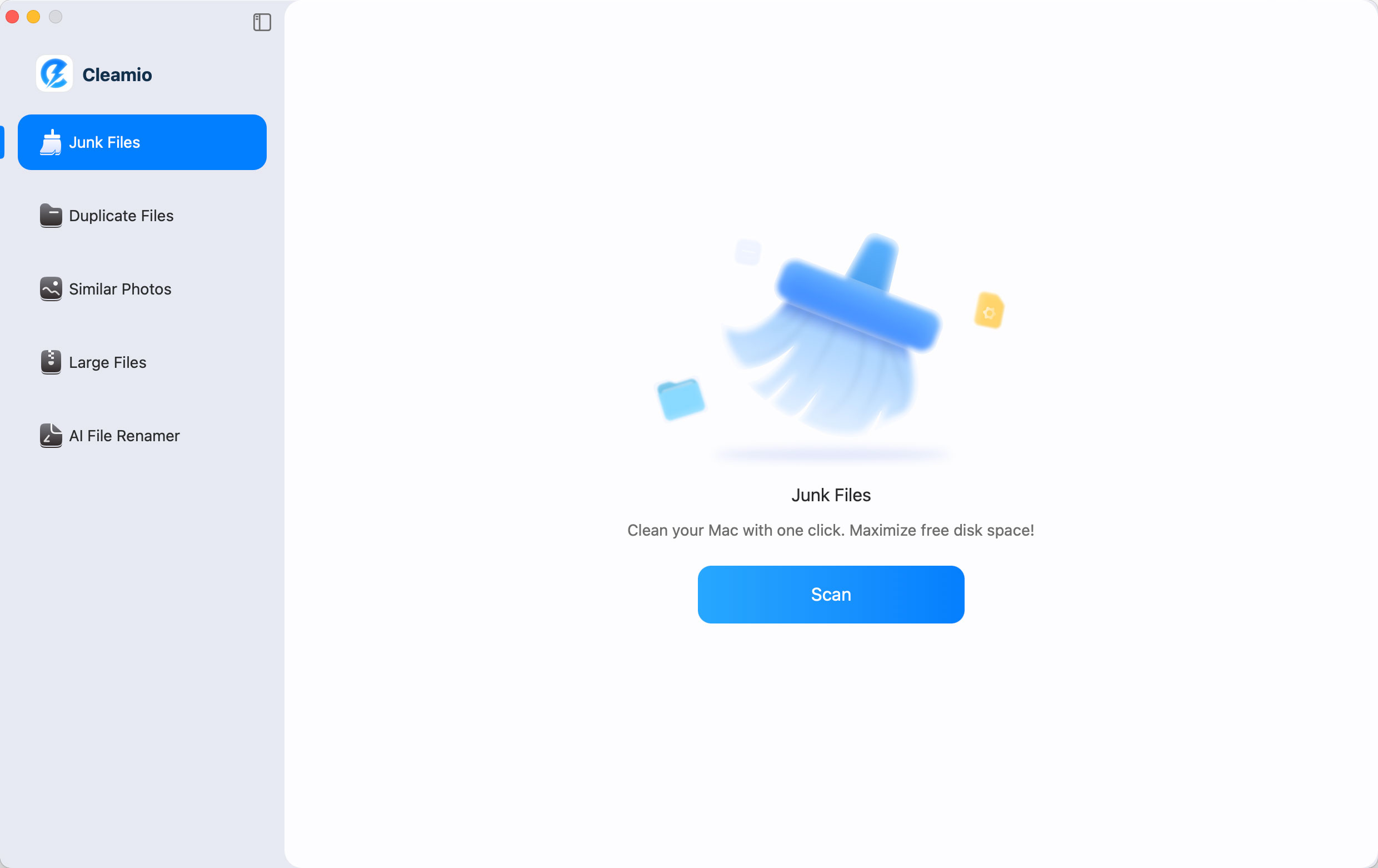
Download, install, and launch Tenorshare Cleamio. Select "Junk Files" from
the left panel and click "Scan".
The scan takes only a few seconds. Cleamio displays detected junk files
and storage usage in real time.
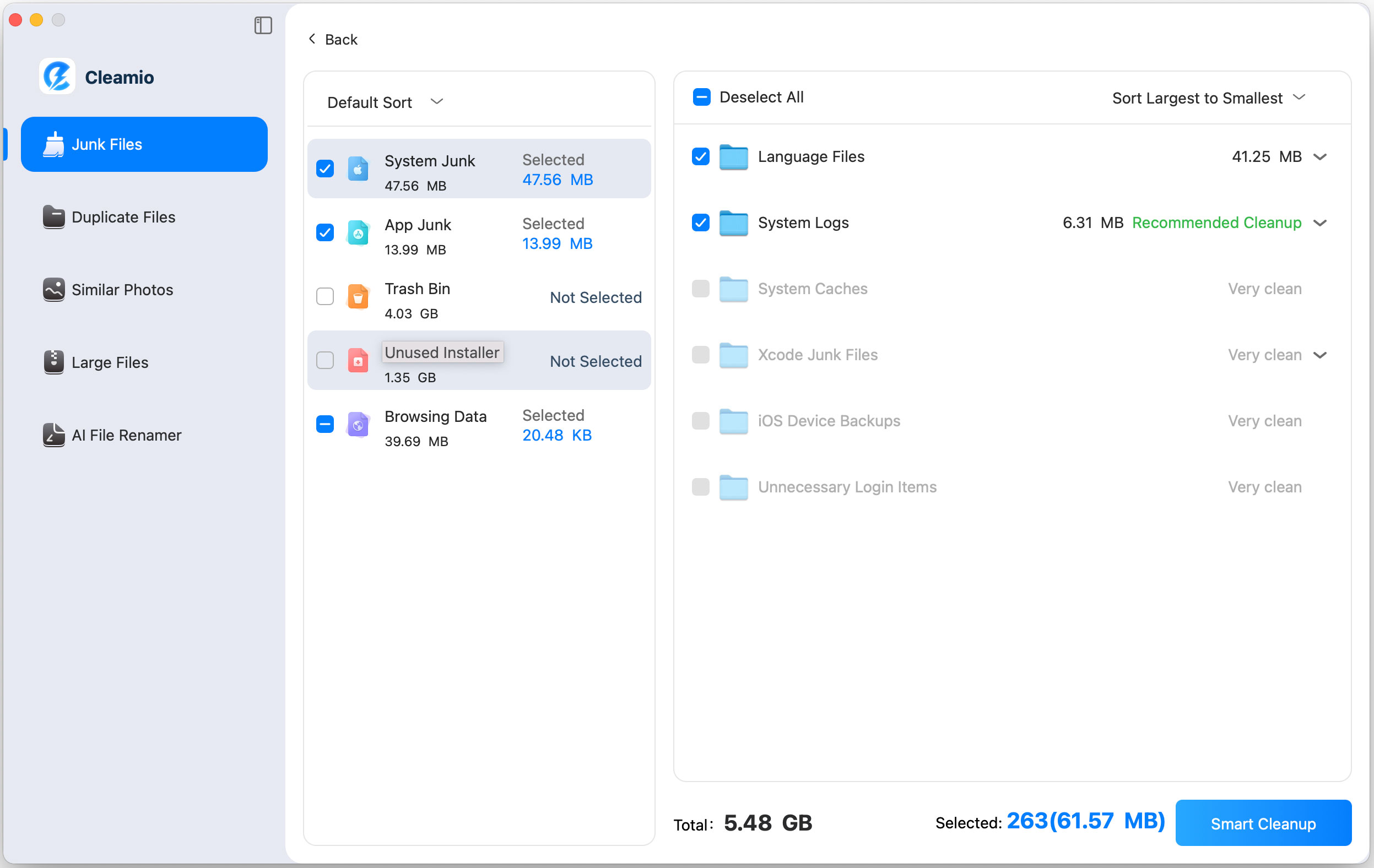
After scanning, Cleamio categorizes all detected junk files. Review the
results and click "Smart Cleanup". The software automatically removes
unnecessary files while protecting important data.
Once cleanup is complete, click ‘OK’ to finish.
4. Network, Proxy, VPN, or Claude Service Issues
Verdict: High latency is often an external infrastructure
issue rather than a code-level bug.
If you experience Claude code terminal slow behavior where the AI "hangs"
mid-sentence, the bottleneck is almost certainly your network. Claude Code
relies on a persistent connection to Anthropic's API. If your packet loss is
high or your route to their servers is congested, the "streaming" experience
will feel broken.
How to tell if the problem is local or service side
When Claude's code is too slow, complaints surface, it's often during peak
usage hours when Anthropic's API is under heavy load. If your internet speed
is fine but the "thinking" indicator spins for 30+ seconds, the bottleneck
is likely the server. However, if you are using a VPN or a corporate proxy,
your requests may be getting routed through multiple unnecessary hops,
leading to a massive increase in ping.
What to check before changing your setup
Before you assume there is a bug in the software, ask: Is there a way to
make a Claude code faster? The answer often lies in your routing.
Scenarios & Benefits: Disabling a high latency VPN can
reduce response time from around 10 seconds to just 2 seconds. Using a wired
Ethernet connection instead of unstable Wi-Fi can prevent the "reconnecting"
loops that make the CLI feel broken.
Steps to verify connectivity:
Test your internet speed.
Temporarily disable VPN services.
Check proxy settings.
Restart your router.
Verify Claude service status.
Retry the same request.
You may also notice Claude Code terminal slow behavior if network latency
causes delayed streaming responses.
Practical Checklist: How to Make Claude Code Run Faster Long Term
Use this checklist to maintain optimal performance:
Keep projects focused and organized.
Use .claudeignore to exclude unnecessary files.
Archive completed project folders.
Restart long running sessions periodically.
Save important prompts externally.
Keep your operating system updated.
Maintain sufficient free storage space.
Remove unnecessary development tools.
Avoid running multiple resource heavy applications simultaneously.
Monitor memory and CPU usage regularly.
Use Tenorshare Cleamio to clean up your Mac and boost overall system
performance.
Verify network stability before troubleshooting deeper issues.
FAQs about Claude Code Too Slow Issue
Q1: Why is Claude Code so slow now?
It is likely due to a combination of high API traffic and local context
bloat. If your project has grown significantly, the tool is spending too
much time reading irrelevant files.
Q2: How do I speed up Claude Code?
The fastest way to speed up Claude code is to implement a .claudeignore file
and periodically clear your terminal history to reduce rendering overhead.
Q3: Should I clear the Claude Code cache?
Yes. Over time, metadata buildup can lead to fragmented file indexing.
Clearing the cache ensures the AI starts with a "clean slate" for your
project structure.
Q4: Is Claude Code slower than Cursor or Copilot?
Technically, Claude Code can feel slower because it is a "Research-Agent"-
style tool that performs more in-depth thinking than standard autocomplete.
However, with the right optimizations, the difference is negligible.
Conclusion
In summary, fixing a Claude code slow experience requires a
mix of project-level hygiene and system level maintenance. You can eliminate
most lags by optimizing your .claudeignore and managing your session
history. For a truly seamless experience, we recommend
Tenorshare Cleamio to keep your system free of the junk
that causes performance bottlenecks. Optimize today for faster coding!





 iOS Tips & Latest Updates
 Bug Fixes, Unlock Guides
 Giveaways & Freebies





By Jenefey Aaron
2026-09-28 / Mac Optimization