In October 2025, DeepSeek AI released DeepSeek-OCR, an advanced optical character recognition model using a paradigm called contexts optical compression. Unlike traditional OCR that treats documents as individual text tokens, DeepSeek encodes entire pages as compact vision tokens (images or visual embeddings) and decodes them back into text. According to the DeepSeek OCR paper (arXiv, Oct 2025), when compression is below 10×, the model achieves ≈97% accuracy, while even at 20×, it retains around 60% precision.
This breakthrough allows large language models (LLMs) and document AI systems to handle longer documents at significantly lower computational cost. This article explores DeepSeek OCR’s architecture, benchmarks, community feedback, applications, pros & cons, and its integration with PDF workflows.
DeepEncoder: Converts a full document page into a set of visual tokens—essentially, a compressed 2D image mapping.
DeepSeek3B-MoE Decoder: Takes those visual tokens and reconstructs textual output.
This is the core of contexts optical compression: compress in the visual domain first, then decode into text. A single page that might require thousands of text tokens can be represented by only a few hundred vision tokens, reducing memory usage, speeding attention, and lowering costs.
As of Oct 23, 2025, DeepSeek-OCR is officially supported by vLLM.
TOM’s Hardware reported the new model uses vision-text compression to cut token usage by up to 20× while retaining ~97% accuracy under moderate compression.
Deployments on GPU clusters like NVIDIA Spark have already been demonstrated (e.g. by Simon Willison) to run OCR tasks on real documents.
Part 2. Latest Performance & Real Deployments
Benchmarks & Compression Efficiency
In internal tests, compressing under 10× yields ~97% accuracy. Even at 20×, results hover near ~60%.
Media reports show that vision-text compression can cut token counts by 7 to 20× for many documents.
On the OmniDocBench benchmark, DeepSeek-OCR reportedly outperforms equivalent OCR models using far fewer vision tokens.
On 20 October 2025, developer Simon Willison shared how he got DeepSeek-OCR running on an NVIDIA Spark cluster using Claude Code. He dockerized the model, ran inference, and documented the steps.
This shows it’s possible to deploy DeepSeek-OCR outside lab setups and integrate with GPU clusters.
Strengths & Limitations
Strengths
High token efficiency: Vision token compression reduces compute demands dramatically.
Open-source and transparent: Code and weights on GitHub and Hugging Face allow inspection and experimentation.
High fidelity at moderate compression: Maintains layout and structure better than many pure-text OCR models.
Deployment flexibility: Demonstrated running on GPU clusters, integration into vLLM stack.
Limitations
At high compression: At compression > 10×, accuracy drops more sharply.
Performance limitations: Poor scans, handwriting, and stylized fonts can degrade results substantially.
Technical requirements: Requires GPU & software tuning for best results — not trivial for beginners.
Benchmarking limitations: As a new model, independent benchmarks are still limited; claims come mostly from developers.
Safety risks: A companion paper, “Towards Understanding the Safety Boundaries of DeepSeek Models,” flagged vulnerabilities around content bias, harmful output, and discrimination.
Part 3. Community Views & Developer Buzz
In developer forums and Reddit threads, DeepSeek-OCR is viewed not only as an OCR model but as a testbed for vision-based context compression. Some users speculate it could shift how models handle long documents.
The GitHub repository has seen rising stars and forks, indicating strong community interest. On Hugging Face, integration with vLLM and API access allows developers to test deepseek OCR api, deepseek ocr demo, and deepseek ocr pdf pipelines.
Part 4. Applications & Use Cases
Here are scenarios where DeepSeek-OCR shines (or shows promise):
Please swipe to view
Scenario
Why It's Useful
Watch Outs
Large-scale PDF conversion
Convert hundreds or thousands of pages efficiently
Low-resolution scans or handwriting may degrade quality
Academic research
Process scanned articles, tables, images with minimal overhead
Complex formulas, diagrams might need manual cleanup
Document AI / RAG pipelines
Feed longer OCR output to LLMs with fewer tokens
Lossy compression at high ratios can drop details
Historical archives / digitization
Convert old manuscripts, books, or microfilm
Degraded or damaged pages may confuse encoder
Web or mobile OCR apps
Using compact token models to enable on-device or lightweight inference
Deployment complexity and GPU needs may limit reach
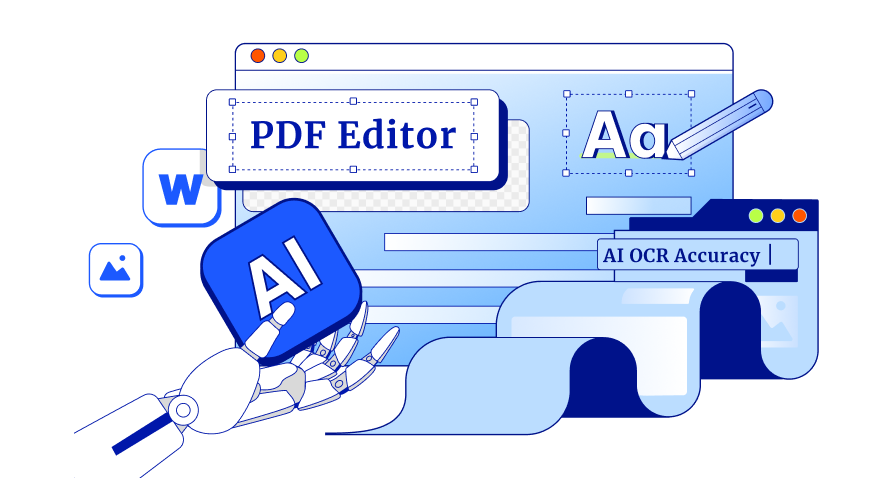
While DeepSeek OCR excels at extracting text from images and scanned documents, you might also need a tool to edit, annotate, and manage your PDFs effectively. This is where Tenorshare PDNob comes in.
Unlike basic OCR tools, PDNob PDF Editor not only converts scanned PDFs into editable text with 99% OCR accuracy, but also offers a comprehensive suite of features for document management. Whether you need to edit text, images, watermarks, or backgrounds, convert PDFs to over 30 formats, or annotate with highlights, stamps, and sticky notes, it provides an all-in-one solution.
Additionally, its Smarter AI technology speeds up PDF reading, summarization, and insight extraction by 300X. If you're looking for more than just OCR, PDNob PDF Editor can transform how you handle digital documents.
How to Edit PDF with Smarter AI OCR
Open PDNob PDF Editor and in the main window, select OCR PDF. This will allow you to browse your computer for the scanned PDF document.
Once it is open, click Perform OCR at the top to convert the scanned PDF into an editable and searchable format.
Conclusion
DeepSeek OCR is an innovative leap forward. By encoding documents as visual tokens and decoding text, it offers a fresh path to efficient, high-capacity OCR. While its promise is clear, it’s still early: performance on tough scans, handwriting, or extreme compressions needs broader validation.
If you're handling medium- or high-volume document jobs today, DeepSeek-OCR is worth experimenting with—especially via its GitHub or Hugging Face demos. But for critical, high-accuracy needs, combining it with fallback tools(Tenorshare PDNob) or human review is wise.
The END
About PDNob
I am PDNob.
Swift editing, efficiency first.
Make every second yours: Tackle any PDF task with ease.
As Leonardo da Vinci said, "Simplicity is the ultimate sophistication." That's why we built PDNob.














By Jenefey Aaron
2026-10-26 / AI PDF